
A Critical View on the Invisible Stylistic Constraints of Women in Corporate Culture
On how women’s once rebellious adaptation to masculine silhouettes and corporate dress styles quietly became part of professional culture – and why visible femininity still struggles to feel fully integrated into ideas of professionalism and competence.
There was a time when women wearing what was considered masculine clothing was seen as an act of rebellion. Flat shoes, trousers, tailored jackets, and straighter silhouettes carried meanings that extended far beyond style. They became associated with autonomy, independence, and resistance against prescribed femininity. These were not simply garments but signals.
To dress “like a man” meant adopting a look associated with power, credibility, and seriousness. It also reflected a desire for greater equality and access to workspaces historically shaped around men and the standards they defined. Rather than imitation, these choices often stemmed from the need to be taken seriously in environments where authority was visually coded as male.
Throughout history, shifts in women’s social roles were often accompanied by visible changes in style and appearance. Shorter hemlines in the 1920s, practical workwear during wartime, and the gradual normalization of trousers for women reflected changing ideas around gender, participation, and freedom. Clothing was never only about aesthetics; in professional settings, it also became a way of navigating environments that had not originally been designed for women as equal participants. The expectations attached to appearance often extended beyond clothing itself, shaping how women were expected to present themselves, move, speak, and take up space.
One particularly visible example emerged in the 1980s with the rise of so-called power dressing. As more women entered leadership positions and male-dominated industries, clothing became part of how competence and belonging were communicated. Structured blazers with padded shoulders, sharp tailoring, and controlled colour palettes mirrored an already established visual language of authority, closely aligned with the male corporate aesthetic of the time and the rise of so-called yuppie culture. In this sense, power dressing was less about self-expression and more about establishing access. It was not about erasing identity but about navigating existing systems. Being taken seriously often meant appearing serious, while seriousness itself remained closely linked to masculine styles. Hence, rather than acting as protection, clothing functioned as a way of belonging and claiming space. It helped signal an understanding of the rules and a right to participate. Style became a strategy rather than an expression.
When femininity appeared, it was often toned down rather than removed entirely. Adopting masculine-coded elements helped reduce friction and avoid judgement – being perceived as too emotional, too soft, too distracting, or not competent enough for responsibility or positions that require authority. In practice, this often meant visually minimizing certain gender-coded differences, not as a denial of identity, but as a way of aligning with expectations shaped around a narrower and more neutral presentation. Over time, these choices became normalized, gradually shifting from intentional signals into habits and expectations.
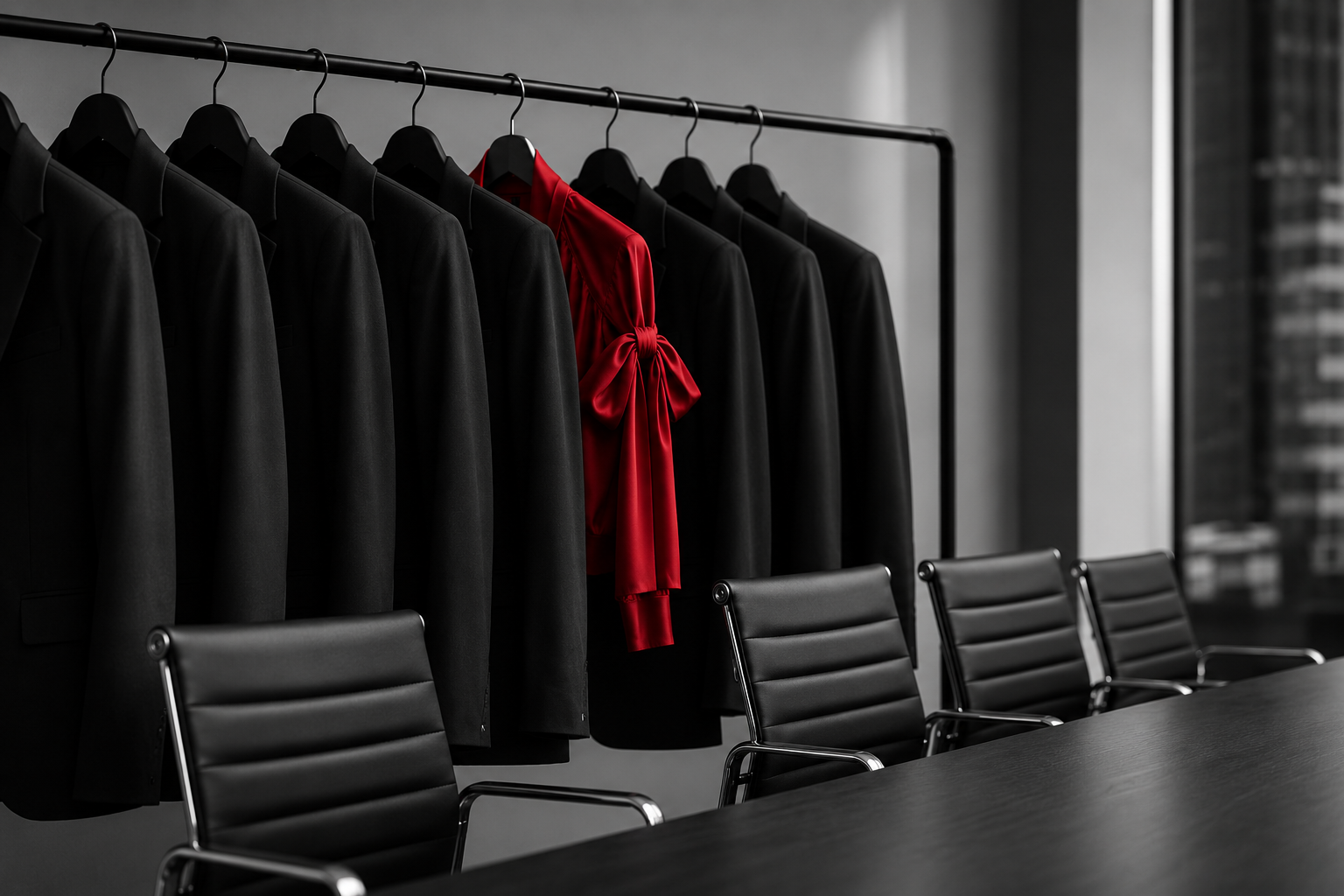
Nowadays, tailored suits, clean silhouettes, and functional outfits rarely raise questions. On women, these styles are often no longer read as masculine but as neutral and standardized – less defined by gender and more by convention. Today, they have become widely accepted as part of professional norms. Yet, seen critically, they still leave little room for visibly feminine expression to feel fully integrated into what continues to be understood as serious or professional. It seems that forms of femininity that are immediately visible or legible – whether through styling or enhancing one’s own body shape – become something to manage rather than something to be fully expressed within the workplace. Therefore, what did not follow the same path of normalization within the workplace is overt femininity!
While masculine dress codes were absorbed into professional standards, expressive femininity remained unstable in its perception. More precisely: colour, ornamentation, focus on the silhouette, or deliberate styling (such as wearing high heels without a clearly justified occasion or defined make-up) continue to be questioned. These elements are often read as signals about supposed competence or credibility rather than as stylistic choices.
In some cases, even something as simple as wearing pink can still be (un)consciously linked to assumptions about seriousness or intellectual depth, reflecting how femininity itself has historically been associated with superficiality, irrationality, or even reduced intelligence. The same applies to styles that are seen as girlish, playful, or delicate. Many of the qualities women were once encouraged to embody have slowly become things they are expected to tone down or control within professional spaces. This is where the idea of rebellion quietly shifts.
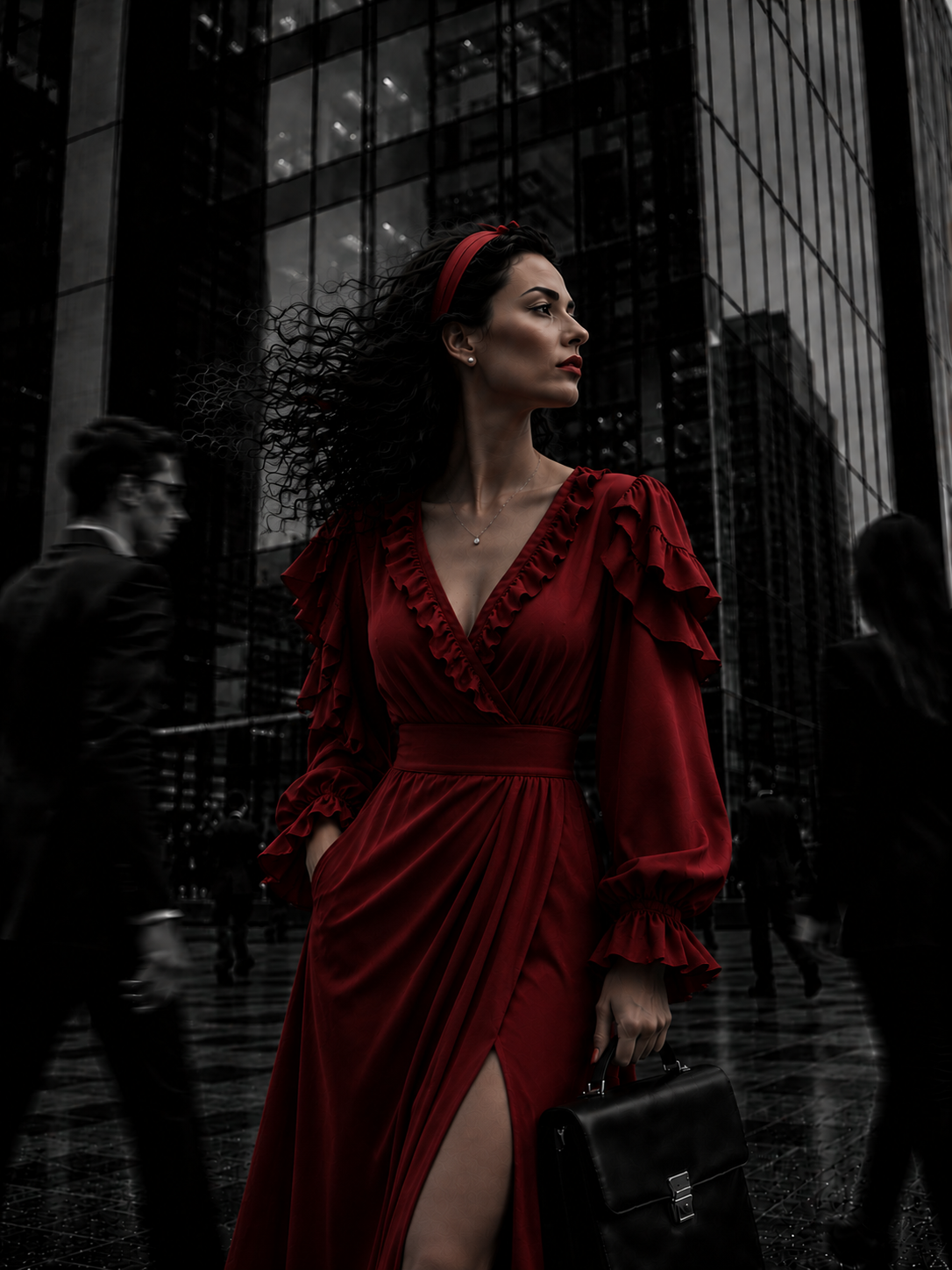
Today, it is no longer particularly radical for women to dress in traditionally masculine ways. Instead, appearing visibly feminine while still expecting to be taken equally seriously can feel far more challenging. Visible femininity is often quickly read as being “overdressed”. However, it is not about being “overdressed” – because who defines excess anyway?
It is about beauty, intention, and visibility, and about the limited space women are often given to define these terms for themselves, especially in professional settings. Additionally, feminine expression is frequently read through suspicion: as a desire for attention, as vanity, or as competition. This judgement does not come only from outside, but is often reinforced between women themselves, shaped by comparison and unspoken hierarchies of who is allowed to be seen, admired, or taken seriously. At its most extreme, this creates a subtle but persistent binary in which women are often expected to choose between appearing intelligent and appearing visibly feminine, as though beauty and competence were somehow contradictory qualities. The assumption itself is irrational, particularly in professional environments where women have already demonstrated capability through education, experience, endurance, and professional achievement.
What is rarely acknowledged is that many women do not dress for an audience at all. They dress for themselves, for comfort, for confidence, for pleasure, for experimentation, or well-being. In this sense, choosing to dress in ways that allow them to show more of themselves, rather than having to hide or tone it down, becomes less about performance and more about self-expression. This can include body-conscious silhouettes, more revealing cuts, or styling that is often read as sensual or “sexy” – not as a statement for others, but simply as a way of feeling comfortable in one’s own body. It resists the expectation to constantly translate appearance into intention, and instead reclaims clothing as something personal rather than strategic or shaped by male-defined standards in the workplace. Yet this often clashes with professional environments in which women are still expected to remain visually restrained, particularly when femininity becomes too noticeable, body-conscious, or expressive.
As an example, choosing to wear a short fitted denim dress with colourful embroidery, over-the-knee boots, styled curls, visible make-up, and playful accessories would still likely be read as “unprofessional” in many workplace environments long before competence itself is ever evaluated. Yet this reaction reveals far more about the narrow frameworks through which femininity continues to be judged than about the person wearing it.
Women should not feel the need to minimize themselves in order to be accepted and seen as professionals.
Seen this way, expressive femininity carries a quiet potential for resistance in modern days. Even today, the expectations placed on women’s appearance remain significantly narrower and more heavily scrutinized than those placed on men. Men are generally granted a much wider visual neutrality, while women continue to be interpreted, evaluated, and read through their appearance in far more complex ways. Men have rarely been required to detach themselves from their own visual identity in order to be perceived as naturally competent. Women, by contrast, have historically been expected to continuously adapt themselves in order to gain the same autonomy and freedom to operate equally within society and professional life.
Seen in this context, the meaning of fashion rebellion within professional culture appears to have shifted. Where resistance once lay in adopting masculine codes as a way of gaining legitimacy and access, it may now increasingly exist in embracing femininity, sensuality, colour, and silhouette without apology. Expressive femininity therefore still carries a quiet potential for resistance – not because it rejects professionalism itself, but because it refuses erasure. Ultimately, it may increasingly reflect a conscious and self-defined choice rooted in authenticity and autonomy rather than conformity. Perhaps true equality within professional culture will only exist once women no longer feel required to suppress parts of their visual identity to be perceived as equally competent.
Considering the issue raised, a series of questions about how professionalism and competence are still defined today become apparent:
- Why does professionalism continue to be measured against standards that emerged within historically male-dominated structures?
- Who is considered competent – and why?
- Is competence really rooted in skill, experience, and thought, or does appearance still shape how competence is perceived?
- Why does appearance continue to function as a shortcut for judgement, even when it has little relevance to actual ability?